



How a crash round works
Each round starts with a short betting window. You place a stake, the multiplier begins at 1.00x and rises, and at a random moment it crashes. If you pressed cashout before the crash, you receive your stake multiplied by the multiplier at that instant. If the crash comes first, the stake is gone.
The appeal is control and speed. You decide when to leave, rounds last seconds, and other players' cashouts are visible on screen. That social layer makes crash feel skill-based, but the crash point is generated before the round begins and does not react to anything you do.
Crash games are among the most popular instant-win titles at crypto sites, and many are provably fair. Studio versions such as JetX and Spaceman use the same idea with themed visuals, and one very well known example has its own guide: Aviator.
Cashout probability and the maths
In a typical crash design with a 3 percent house edge, the chance that the multiplier reaches at least a value m is about 0.97 divided by m. That is why low targets hit often and high targets are rare.
| Cashout target | Chance to reach it | Expected return per 100 staked |
|---|---|---|
| 1.20x | about 80.8% | 97 |
| 1.50x | about 64.7% | 97 |
| 2.00x | about 48.5% | 97 |
| 5.00x | about 19.4% | 97 |
| 10.00x | about 9.7% | 97 |
| 100.00x | about 0.97% | 97 |
The last column is the key. Whatever target you choose, the average return is the same, because a higher payout is exactly offset by a lower chance. Only the volatility changes. A 1.20x target wins often with small gains and rare painful losses, while a 100x target loses almost every round for the chance of a large hit.
House edge and crash game RTP
Crash game RTP is the share of all stakes returned over a very long run. Many titles publish a figure in the range of 96 to 97 percent, so the house edge is roughly 3 to 4 percent. JetX by SmartSoft is commonly listed at 97 percent, while Spaceman by Pragmatic Play has no figure worth quoting here, so you should confirm the number in the game's own info panel at your casino, since operators can use different configurations.
The edge is usually built into the crash distribution. A share of rounds, around 3 percent in a 97 percent game, ends instantly at 1.00x, which means even a cashout the moment the round starts loses. This is how the house gets paid even if you always cash out early.
Read more about how edge converts to expected loss in our house edge guide. At a 3 percent edge, betting 1,000 units in total gives an expected loss of 30 units, with swings far larger than that in the short term.
Crash gambling strategy: what works and what does not
Every crash gambling strategy comes down to two choices: how much to stake and where to cash out. Neither changes the average return, but they change how fast you lose and how often you win. Common approaches look like this.
- Low fixed target (1.3x to 1.5x): frequent small wins, slow bankroll movement, the occasional large loss from an early crash.
- High target (10x and above): long losing streaks, rare big wins, high variance.
- Two-bet split: some games let you place two bets, one at a safe target and one chasing a high multiplier.
- Martingale (doubling after a loss): loses badly during a losing streak because table limits and your bankroll run out first.
Each round is independent. A long run of low crashes does not make a high one "due", and patterns in the history chart carry no information. Any tool that claims to predict the crash point cannot do so, since the result is created by a random generator or a hash that you cannot see in advance.
The sensible use of strategy is bankroll control: pick a stake that is a small fraction of your budget, choose a target you are comfortable with, and stop at a limit set before you start. See gambling budget for a simple way to set that limit.
Auto cashout and discipline
Auto cashout lets you enter a multiplier in advance, and the game withdraws your bet automatically when it is reached. It removes the temptation to wait for one more tick, and it is also faster than a human click, which matters when a crash can come after a fraction of a second.
Use it as a rule enforcer. Decide the target and a stop-loss or stop-win total before the session, then let the tool do the work. Without that, many players raise targets after a loss, which is how short sessions turn into large losses.
Are crash games rigged? Provably fair crash
Crash game provably fair systems commit to a chain of hashes in advance, then map each hash to a crash multiplier with a published formula. After the round you can repeat the calculation and see that the multiplier was fixed before you placed your bet. That removes the worry that the casino picks the crash point after seeing your stake.
Provably fair crash proves honesty of the result, not generosity of the odds. It tells you nothing about the edge, which you must read from the RTP. Some studio games rely on certified random number generators that labs test instead, so the verification method depends on the title.
The real risks are elsewhere: unlicensed operators, delayed withdrawals and fake prediction apps. Stick to sites with clear licensing, as covered in casino licences.
A bankroll example
Suppose you have a budget of 100 units and bet 2 units per round with a 1.5x target. You win about 65 percent of rounds and gain 1 unit each time, and lose 2 units on the other 35 percent. After 100 rounds that is roughly 65 units won and 70 units lost, a net result near minus 5 plus or minus a large random swing.
The same budget at a 10x target wins around 10 rounds in 100 and pays 18 units net each time, but the losing runs can last dozens of rounds. Both paths average out to the same small loss, and that gap between the average and what you actually feel is exactly what crash volatility is.
How crash compares with other fast games
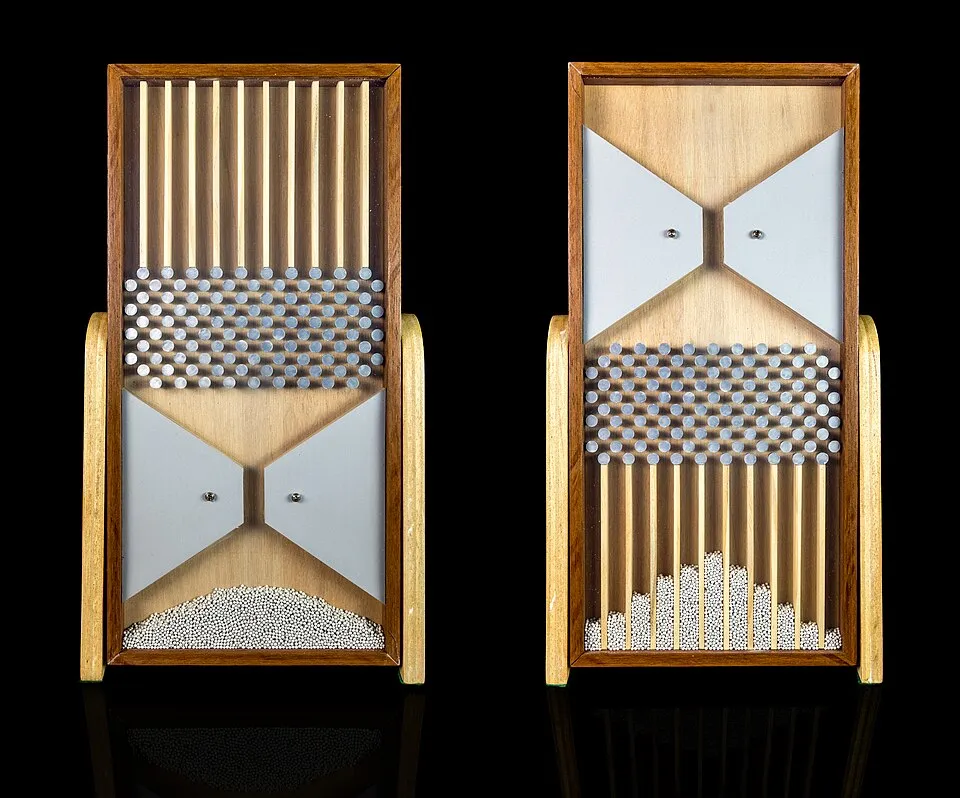
Crash sits between a slot and a table game. You have an active decision, like blackjack, but the underlying maths is a fixed probability curve, like a slot with a chosen volatility. Plinko works the other way: you choose a risk setting and the outcome follows a distribution of paths, which you can study in our plinko guide.
The speed is the main danger. A round every ten to fifteen seconds means hundreds of bets in an hour, so the house edge applies many times over. Setting a time limit matters as much as a money limit.
FAQ
What is crash gambling?
A game where a multiplier rises until it crashes at a random point. You win your stake times the multiplier if you cash out before the crash.
What is the crash game RTP?
Commonly 96 to 97 percent, which means a house edge of 3 to 4 percent. Check the figure shown in the specific game.
Is there a winning crash gambling strategy?
No strategy changes the average return. Choices of stake and target only change how volatile your results are, and doubling after losses is especially risky.
Is a crash game provably fair?
Some are, mainly at crypto casinos, and you can verify each crash point from published hashes. Studio titles like JetX and Spaceman use certified generators instead.
What are JetX and Spaceman?
JetX is a crash game by SmartSoft and Spaceman is one by Pragmatic Play. Both use the same rising multiplier idea with their own themes and features.