





How the game works
The online plinko casino game is based on the board from a famous television show, but it is a random game of chance. You set a bet, choose settings and press drop. A ball falls through rows of pegs, bounces left or right at each peg and lands in one of the slots on the bottom row. Each slot has a multiplier, and your payout is the stake times that multiplier.
The slots in the middle are hit often and pay little, often less than your stake. The slots at the edges are hit rarely and pay the most. The game is simple and fast, and many versions are provably fair, so you can check each ball path against seeds after the drop.
Plinko real money versions exist in studio releases from several providers and in crypto casino in-house games. Rules are similar, but the multipliers differ, so look at the table for the exact version you play.
Rows and the probability behind each slot
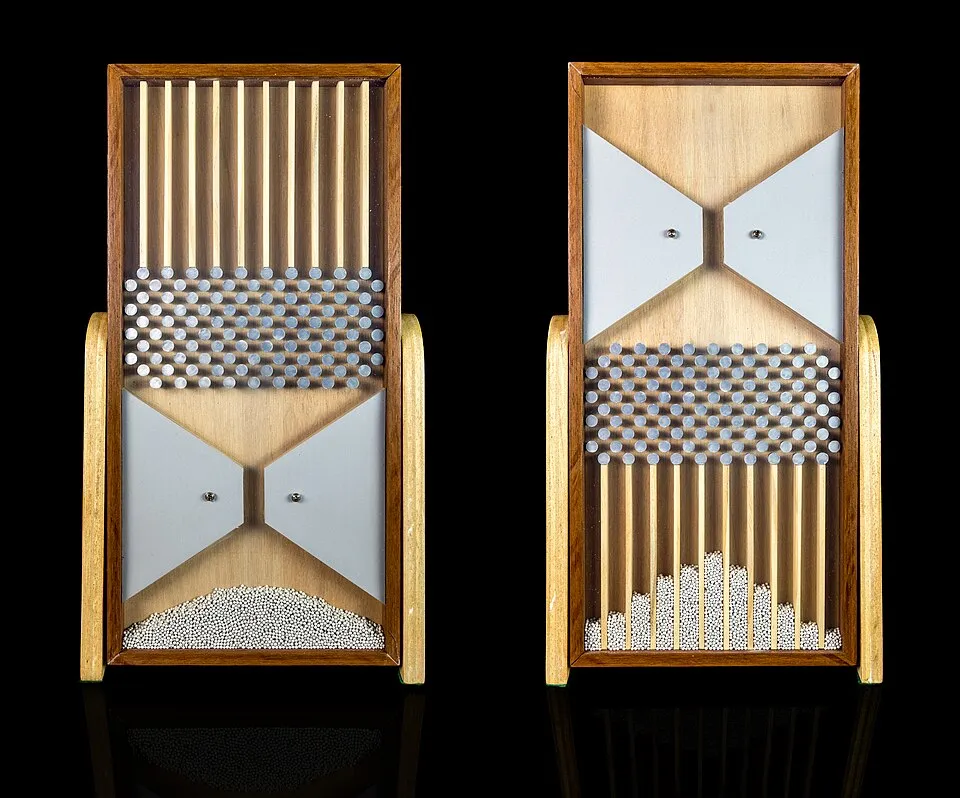
Think of each peg as a coin flip: left or right with equal chance. After 8 rows, a ball has taken 8 flips. The slot it reaches depends on how many of those were rights. That creates a bell-shaped distribution, with the centre far more likely than the edge.
| Slot (from the left) | Paths out of 256 | Chance |
|---|---|---|
| 1 and 9 (edges) | 1 each | 0.39% each |
| 2 and 8 | 8 each | 3.13% each |
| 3 and 7 | 28 each | 10.94% each |
| 4 and 6 | 56 each | 21.88% each |
| 5 (centre) | 70 | 27.34% |
This is the exact distribution for 8 rows. The edge slot is reached only by 8 left bounces in a row or 8 right bounces in a row, so it appears about once in 128 drops across both edges together. More rows mean more slots and a wider spread, which pushes the edge probability lower and lets the game offer a bigger top multiplier. Common settings range from 8 to 16 rows.
Risk levels: low, medium and high
The risk level does not change the pegs. It changes the multipliers printed under the slots. Low risk gives modest edge payouts and keeps the middle slots at or near 1x. High risk makes the middle slots pay very little and puts the large numbers at the edges.
- Low: frequent returns near your stake, small top multiplier, a slow balance drift.
- Medium: a balanced spread, with many drops below the stake and a few strong ones.
- High: most drops return a fraction of the stake, rare drops pay many times the stake.
Plinko high risk is a volatility setting, not a better deal. The casino designs each table so that, weighted by the slot probabilities, the average return is the same across risk levels for a given row count. A typical figure for the Spribe version is 97 percent. Other providers publish values up to 99 percent for their own games, so confirm the number in the specific game.
Plinko RTP and a worked example
Plinko RTP is the long-run share of stakes returned. To see how it works, take a simplified 8-row example with these made-up multipliers across the nine slots: 5.6x, 2.1x, 1.1x, 1.0x, 0.5x, 1.0x, 1.1x, 2.1x, 5.6x. They illustrate the method and are not a real table.
Multiply each multiplier by its probability: the edges give 2 x 5.6 x 0.0039, which is about 0.044. The second slots give 2 x 2.1 x 0.0313, about 0.131. The third slots give 2 x 1.1 x 0.1094, about 0.241. The fourth slots give 2 x 1.0 x 0.2188, about 0.438. The centre gives 0.5 x 0.2734, about 0.137. Adding them gives about 0.99, or an RTP near 99 percent.
A designer can shave a few points by lowering any slot, which is how a 97 percent version appears. On 1,000 units of total bets at 97 percent, the expected loss is about 30 units, and real results swing around that figure. Our house edge guide explains why.
Plinko strategy: what is real
There is no way to aim a drop. The ball path is random, so no timing, bet size or click pattern changes where it lands. Plinko strategy therefore means picking a risk level and row count that fit your budget, and controlling stakes.
- Match volatility to bankroll: high risk needs a bigger bankroll, since long runs of sub-stake returns are normal.
- Use smaller stakes with more rows and high risk: the rare big payout only arrives if you can survive the dry spells.
- Avoid progression systems: raising your stake after losses speeds up losses, and the previous ball has no effect on the next one.
- Treat the auto mode with care: repeated drops add up quickly, so set a stop limit.
Plinko can feel patterned because a long history of centre landings looks like a trend. It is not: each drop is independent. For a wider view of managing swings, see gambling budget.
Plinko compared with crash and slots
Plinko is a pure chance game with a chosen volatility. You have no decision during the drop, unlike crash games, where you choose the cashout moment. Compared with a slot, the maths is transparent: you can read every multiplier and compute the odds, while a slot hides them in its reel strips. If volatility language is new to you, slot volatility covers the same idea in slot terms.
The speed is similar to crash, and so is the danger. A drop takes seconds, and auto mode can run hundreds in a few minutes. Decide your total budget and time limit before you start, and stop when you reach them. Adults 18 and over only.
What changing the rows does
Going from 8 to 16 rows keeps the average return the same but stretches the board. With 16 rows there are 17 slots, and the edge slots are reached by 1 path in 65,536, so the printed top multiplier can be far larger than on 8 rows. The middle becomes even more crowded, which means more drops land near the stake or below it.
For a small bankroll, fewer rows with low risk give the calmest session. For a player who accepts long dry spells in exchange for the chance of a large hit, 16 rows with high risk is the extreme setting. Neither is smarter, they simply place you at different points on the volatility scale.
Choosing a version to play
- Check the stated RTP in the game info and compare versions, since a 99 percent table is better than a 97 percent one.
- Look at the top multiplier for your chosen rows and risk, and at the maximum win limit.
- Prefer licensed casinos, as explained in casino licences.
- Try the demo or the lowest stake first, if the site offers it, to feel the variance.
Sizing bets for a game with fast rounds
Plinko rounds take seconds, so the number of bets per hour is high and the expected loss grows quickly. At a 99 percent RTP, 600 drops of 1 unit have an expected loss of about 6 units, while at 97 percent it is about 18 units. The edge matters more than any pattern you think you see.
Set a session budget before the first drop and divide it into a large number of bets, so that a run of low slots does not end the session early. High risk needs a bigger cushion than low risk, because long stretches below 1x are normal. See gambling budget for a simple method.
FAQ
What is a plinko casino game?
It is a game where a ball drops through pegs into multiplier slots. You choose rows and a risk level, and the ball path is random.
What is the plinko RTP?
It depends on the version. Some versions, such as the BGaming one, advertise up to 99 percent, while other providers use lower figures. Spribe and operators publish the exact number for their own version. Check the game info.
Is there a plinko strategy that works?
No. The path is random, so strategy only means choosing risk, rows and stake to match your budget. It cannot create an edge.
What does plinko high risk change?
It moves the big multipliers to the edge slots and lowers the middle ones. Wins become rarer and larger, while the RTP stays about the same.
Can I play plinko for real money?
Yes, at many licensed and crypto casinos. Use a stake you can afford to lose and set limits first.